
What Is an HDMI RF Modulator? How does it work?
What Is an HDMI RF Modulator? An HDMI RF Modulator is a device that converts HDMI signals into RF (Radio Frequency) signals, allowing modern HDMI sources to work with older TVs and coaxial cable systems. Their usefulness becomes apparent anywhere coaxial wiring is installed in the walls - think older hotels, hospital wings, and apartment buildings - where content must be distributed digitally without requiring HDMI inputs on every receiving TV. The modulator accepts inputs such as HDMI, composite video, or other formats, and converts them into a modulated RF signal that any television on the coaxial network can tune in and display. That compatibility is crucial for older sets and lets businesses reuse existing coaxial infrastructure while feeding it from modern HDMI sources, enabling multi-room distribution to hundreds of TVs without rewiring.
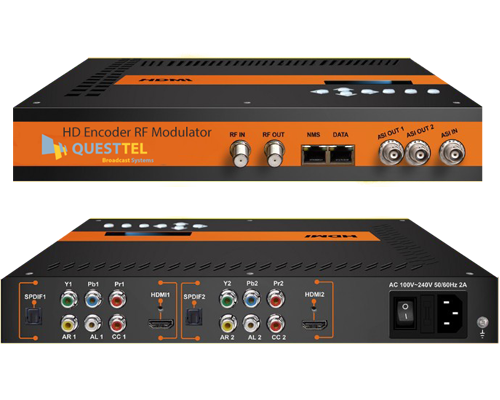
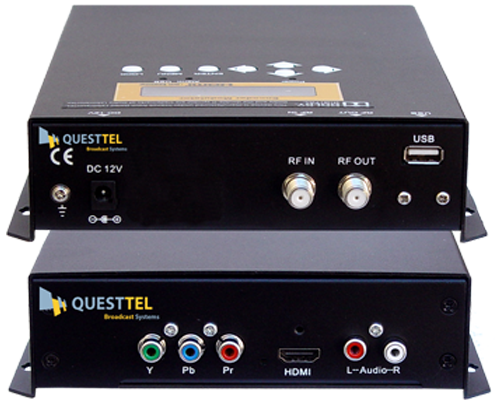
Types of HDMI RF Modulators There are several classes of HDMI RF modulators, each designed for a particular use or system need. QuestTel's Digital RF Modulators (ATSC, DVB-T, ISDB-T, QAM) convert HDMI signals into digital RF formats matched to the TV standard used in each region. Single-channel encoder modulators such as the QuestTel B-QAM-HDMI-1CH and the QuestTel B-ATSC-HDMI-1CH (1 Ch HDMI/YPbPr/CVBS to ATSC Compact Encoder Modulator) handle one source at a time. Multi-channel modulators such as the B-QAM-HDMI-IP-2CH and B-QAM-HDMI-IP-4CH accept several HDMI inputs and assign them to separate channels so multiple programs can be delivered simultaneously.
How Does an HDMI RF Modulator Function? The workflow breaks down into four stages - connectivity, signal modulation, channel coding, and distribution. Each stage plays a distinct role in moving the source content from an HDMI cable onto the coaxial network and into every TV on the system.
Connectivity An HDMI cable links the content source - a Blu-ray player, streaming box, camera, or computer - to the modulator's HDMI input. This is the only cable the source device needs; from here the modulator takes over signal handling.
Signal Modulation The modulator encodes the incoming video, typically with MPEG-2 or H.264 compression, then maps the encoded stream onto an RF carrier compatible with the target broadcast standard (QAM, ATSC, DVB-T, or ISDB-T).
Channel Coding The modulated signal is placed on a specific channel frequency. See the CATV QAM or ATSC frequency tables for the exact center frequency of each channel number.
Distribution The RF output is injected into the coaxial plant through the building's existing wiring. Each TV tunes to that channel the same way it tunes any other broadcast, decoding picture and sound at the receiving end.
Common Applications RF modulators show up wherever coaxial wiring already exists and needs to carry modern content. Hotels and hospitals use them to push a central HDMI feed to rooms across the property. Schools and universities distribute a single lesson or announcement to every classroom at once. In homes and small venues, a modulator lets one streaming or disc player feed every coax-connected TV in the building without running new HDMI cable.
Final Thoughts An HDMI RF modulator is a core building block in any broadcast-style distribution system: it transforms HDMI into RF so content can reach many TVs at once over existing coax. Understanding which standard (QAM, ATSC, DVB-T, ISDB-T) your facility uses, and whether you need single-channel or multi-channel output, is what determines the right unit. For residential, commercial, or academic deployments, QuestTel offers a full lineup of encoder/modulators that cover every standard and channel count - a cost-effective way to integrate modern HDMI sources with legacy analog infrastructure.
Frequently Asked Questions
What is the difference between an HDMI RF modulator and an HDMI splitter? An HDMI splitter duplicates an HDMI signal to multiple HDMI outputs. An HDMI RF modulator converts the HDMI signal into an RF channel that travels over coaxial cable, so it can reach TVs with a coax input - including older sets that have no HDMI port at all.
Can I use an HDMI RF modulator with a 4K source? No. If the source is 4K, the modulator will typically downgrade the video to 720p or 1080p before modulating it. See video resolutions for how these formats compare.
How many TVs can one RF modulator support? With the right combination of RF amplifiers and splitters, a single modulator channel can feed as many TVs as the coaxial network can reach. QuestTel's modulators are deployed to serve hundreds of TVs in hotels, hospitals, and academic campuses.
What are the differences between QAM, ATSC, DVB-T, and ISDB-T? These are regional digital TV broadcast standards. QAM is used for cable in North America. ATSC is the over-the-air standard in the United States, Canada, Mexico, and South Korea. DVB-T covers Europe and parts of Asia, and ISDB-T is used primarily in Japan and most of South America.
Is there a noticeable delay when using an RF modulator? Only minimal. Encoding and modulation add a small amount of latency - well under a second - and QuestTel's modulators are tuned for low-latency output so the viewing experience stays responsive.
Do I require a separate encoder, or does the modulator handle encoding? QuestTel's HDMI RF modulators such as the B-QAM-HDMI-1CH and B-QAM-HDMI-IP-4CH are all-in-one encoder/modulators. A single unit performs both MPEG-2 or H.264 encoding and RF modulation, so no separate encoder is needed - which simplifies installation and lowers equipment cost.
QuestTel shall have no liability for any error or damage of any kind resulting from the use of this document.